
Indiana – Colonization
Letter to Horace Greeley, editor of the New-York Tribune

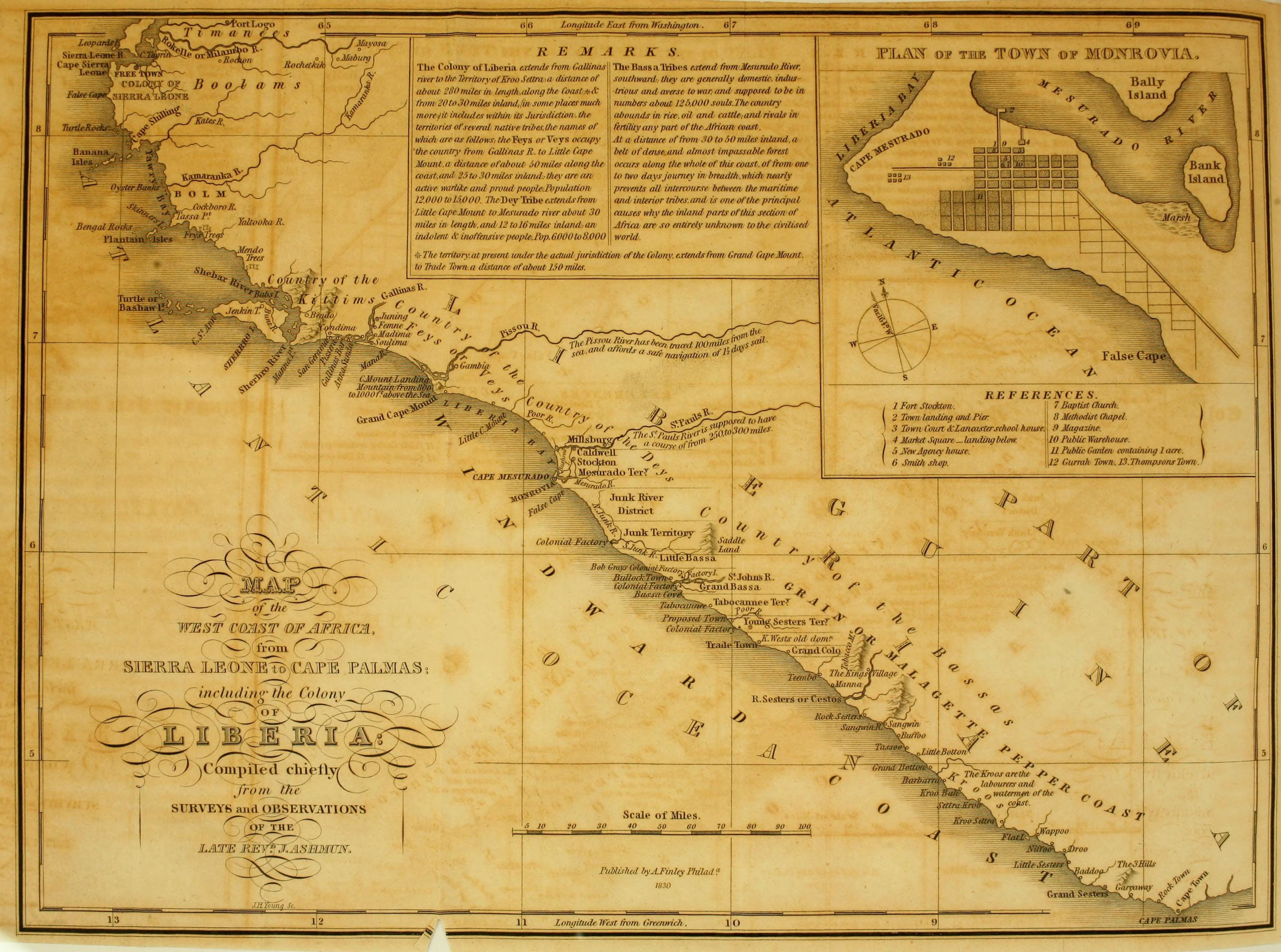
As this letter to the editor and its succeeding essays reveal, there were few issues as likely to raise James McCune Smith’s ire – besides slavery, racial bigotry, irresponsible medical practices, and so on, of course – as schemes for colonizing and promoting emigration of African Americans outside the United States. It even led him to later conduct a vigorous and sometimes unfair attack on his lifelong friend Henry Highland Garnet, who had come to support emigration schemes in certain contexts. (They later reconciled.)
This ire was informed, in part, by McCune Smith’s unshakable conviction in the truth of one of his most distinctive but little-cited ideas: that African Americans had arisen as a new and indigenous American people. Though they have diverse ancestry from many parts of the world – especially Africa and Europe – their origin story is distinctively American, and they have a distinct destiny to fulfil in America, their native land.
As these and other writings also reveal, neither indigeneity nor race were fixed or essential for McCune Smith. Rather, new peoples regularly arise, evolve, and disappear over time – African Americans among them. Only humanity itself – who all share one ‘sweet human brotherhood’ – is essential. Human diversity, on the other hand, is the product of change caused by geography, climate, and ‘amalgamation.’ Hence, McCune Smith looked askance at reductive efforts to classify the wide variety of peoples that then existed into a few, essentialized races, especially since this ‘rage for classification’ (The Destiny of the People of Color, 1843, p. 9) was so often motivated by the search for justification for dividing, exploiting, hating, and oppressing others.
For McCune Smith’s promised essays against colonization, see:
‘African Colonisation - The Other Side [With Prefatory Note]’
‘African Colonisation - The Other Side, No. II’
~ This entry is part of my project of identifying, compiling, and editing the complete written and spoken works of James McCune Smith (1813-1865) in association with Northumbria University and funded by the British Academy. ~
Title: Indiana – Colonization
Co-author(s):
Date: 21 August 1851
Source: New-York Daily Tribune, 22 August 1851, p. 4 (In LOC’s Chronicling America)
Text:
Indiana―Colonization.
NEW-YORK, Thursday, Aug. 21, 1851.
To the Editor of The New-York Tribune:[1]
Following up the war on the ‘Blacks,’ ‘Negroes,’ ‘Colored People,’ &c., which you began shortly after March 7, 1850,[2] you have to-day[3] again applied the lash in the form of the most infamous libel ever uttered against the American People of the Free States, to wit: That they would vote in majorities for a law to violate the obligation of contracts[4] with a portion of their fellow-citizens.
We Blacks[5] have remained so cool under your fire that it glances back on yourself, and with an effect so telling that your sanity will give way[6] if we keep quiet much longer. To avert such a calamity (for I confess that your jerky style is a pleasant stimulant, and plead guilty to some lingering memory of what you have inadvertently done for the cause of Freedom,[7] however unpleasant the waking up to the fact you only meant freedom for Whites)―I propose to say a word in your column on the views we Blacks hold in opposing African Colonization―that is to say, if you will print what I write―as I write it.[8] It will occupy less space than has appeared in The Tribune in favor of that scheme. The language shall be no harsher than you have used, nor coarser.
I will strive to be as lenient as possible on the brazen hypocrisy with which one Horace Greeley, having crawled into power and wealth on the cause of Freedom, and partly over the backs of the Blacks, (who helped boost him,)[9] has recently turned tail on the one and hurled anathemas against the other, hypocrisy is all that he has written about Equal Rights for Blacks before March 7, 1850, hypocrisy in all that he has written against the Fugitive Slave Law since October, 1850. JAMES MCCUNE SMITH.
[1] McCune Smith wrote this letter out of mounting frustration with what he saw as Tribune editor Horace Greeley’s betrayal of African Americans through his support for expatriating them to colonies outside the United States (colonization), and his softness on compromise legislation meant to mollify the slave states and prevent the dissolution of the Union; Greeley’s editorial remarks on Indiana’s adoption of anti-black laws was the last straw. See footnotes below.
[2] Daniel Webster of Massachusetts had given a speech in the U.S. Senate on this date in which he supported expatriating African Americans to colonies outside of the United States, which Greeley also supported. See The Compromise Resolutions: Speech of Hon. Daniel Webster, of Massachusetts, in Senate of the United States, March 7, 1850, on the Compromise Resolutions Submitted by Mr. Clay on the 25th of January (Congressional Globe Office, 1850), 14 (In Internet Archive). See also James McCune Smith, ‘African Colonisation - The Other Side [With Prefatory Note]’, National Anti-Slavery Standard (New York, NY), 28 August 1851.
[3] Greeley wrote for the Tribune of 21 August 1851 that the ‘People of Indiana, at their late Election, have by special vote ratified’ a trio of provisions abridging rights and privileges of ‘negro and mulatto’ Americans ‘and made it part and parcel of their New Constitution.’ Though, he insisted, he ‘abhor[red] and oppose[d] all such enactments as tyrannical, unjust, and in palpable violation of the fundamental basis of our Declaration of Independence,’ the ‘fact of its passage is none the less a fact because we don’t like it.’ See ‘Worth Considering’, New-York Tribune (New York, New York), 21 August 1851 (In LOC’s Chronicling America).
[4] Indiana’s 1851 constitution contained provisions which proscribed rights and privileges of ‘negro[s]’ and ‘mulatto[s],’ including the invalidation of all contracts made with people of these categories. See Legislative Reference Bureau, Constitution of the State of Indiana and of the United States (Wm. B. Burford, 1922), 40 fn47. McCune Smith here disputed Greeley’s characterization of this as the will of the people of Indiana. He would go on to present these black codes as examples of many such unjust laws that were instituted by means of political ‘machinations’ of pro-slavery interests rather than by the will of the people. See ‘African Colonisation I,’ NASS, 28 Aug 1851 (In Internet Archive).
[5] McCune Smith isn’t known to have capitalized ‘Black’ as it pertained to race or skin colour. (No surviving document in his handwriting uses this capitalization.) By contrast, Greeley – who McCune Smith regularly accused of being an inveterate racial bigot – regularly capitalized these terms when used in relation to race or skin colour. (Greeley regularly capitalized other non-proper nouns and adjectives as well to highlight social and political concepts under discussion.) The capitalization of ‘Black’ and ‘Blacks’ in McCune Smith’s letter here is likely Greeley’s editorial change, as is the capitalization of ‘Whites’ further on. Writings and footnotes for this James McCune Smith project follow his practice of use – or rather, non-use – of capitalization in these contexts.
[6] This isn’t the last time McCune Smith would question Greeley’s sanity in relation to his writings and attitudes toward African Americans and his support for colonization. See, for example, ‘Letter from Communipaw [4 February 1852]’, Frederick Douglass’ Paper, 12 February 1852 (In NY Heritage Digital Collections) and ‘Mr. Horace Greeley’s Dislikes’, The Weekly Anglo-African, 10 March 1860 (In Internet Archive).
[7] Greeley was a staunch, lifelong opponent of slavery: he used his Tribune, in part, as an anti-slavery organ, frequently describing slavery as an unmitigated evil and calling for its abolition. However, Greeley opposed radical abolitionism: he favoured gradual emancipation and a tempered, pragmatic approach to anti-slavery rhetoric and action. He also supported colonization as the best means of undermining slavery and ending racial conflict and oppression. See Glyndon G. Van Deusen, Horace Greeley: Nineteenth-Century Crusader (University of Pennsylvania Press, 1953), 12, 26–27, 51, 66, 69, 89–92, 110–11, 116, 124.
[8] When Greeley refused to publish ‘African Colonisation’ in the Tribune, McCune Smith turned to the National Anti-Slavery Standard and its editor Sydney Howard Gay, who obliged. See ‘African Colonisation I,’ NASS, 28 Aug 1851 (In Internet Archive).
[9] Greeley responded to this and McCune Smith’s other arguments in his editorial ‘Remarks’ on this letter: ‘We do not quite comprehend the drift of the foregoing; but, since it was evidently intended to be smart, and seems calculated to increase Mr. Smith’s consequence among his brethren, we cheerfully make room for it. His proposed essays on African Colonization, however, we respectfully decline, since the writer is manifestly in a frame of mind utterly unsuited to so profound and grave a question. A man who can affirm that we have prosecuted a war upon the Blacks by uttering a most infamous libel against the White people of the Free States, is clearly in no condition to prosecute a public discussion. He should rather confine himself to the manufacture and utterance of abusive personalities, for which bad manners and rage rather qualify than unfit him. / But, while we decline Mr. Smith’s essays, we will thank some colored man who knows how to use decent language, to write us a practical answer to the eminently practical questions, ‘What so such votes as ‘that just taken in Indiana mean? and what ‘is to be done with reference to them?’ It [is] quite needless to argue to us that people ought not to vote so; we have been arguing that, to the best of our ability, any time these twenty years, and with what result? Consider the recent popular votes on Equal Suffrage in our own State, in Connecticut, in Wisconsin, &c. and now this vote in Indiana, and let us see clearly to what goal the popular mind is tending. We would know the truth and proclaim it―not what we would have true, but what is true―not merely what ought to be, but what plainly will be. We have done nothing to boast of for the Blacks nor any body else; we certainly never asked any ‘boosting’ at their hands, and are utterly unconscious of having received any; and, most surely, if we have lived and labored with a primary eye to being ‘boosted,’ the Blacks are the very last class of our population in whose behalf we should have made either efforts or professions. Those who are flat on the ground are not in a good attitude for ‘boosting,’ however zealous their good will.―But all this is of little consequence. The only question of moment is this―Assuming that we have misinterpreted the recent popular votes with respect to the Political Rights of the Colored Race, what do these votes really mean? We will thank some sane and well-bred African to give us his ideas on this point. Ed.’ See ‘Remarks’, New-York Daily Tribune (New York), 22 August 1851. (In LOC’s Chronicling America)