
Lee's Surrender – Peace
James McCune Smith on the defeat of the Confederacy and what might follow

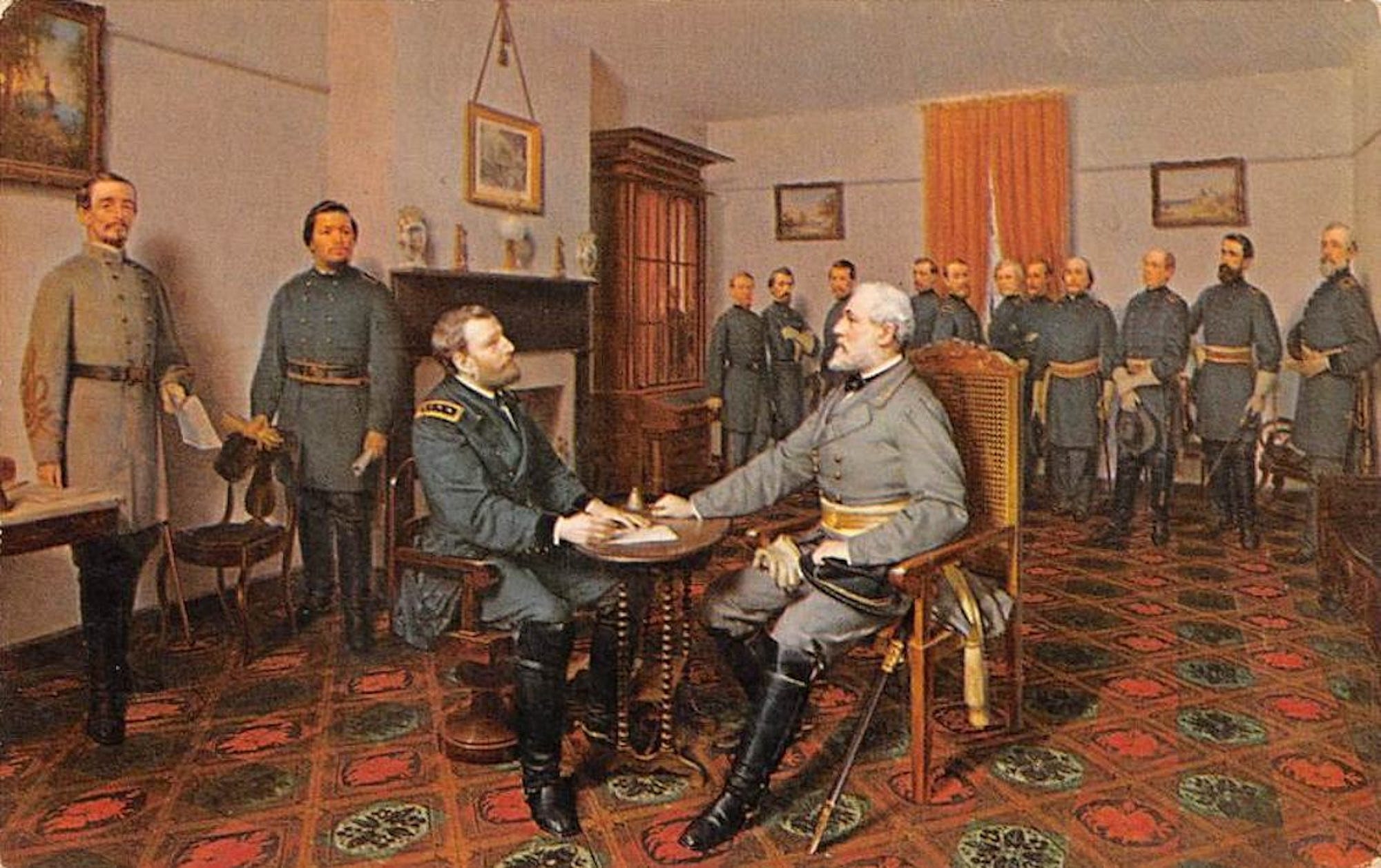
During his tenure of late October 1864-late May 1865 as lead editorial writer for the Anglo-African, James McCune Smith commented on the escalating developments of the Civil War. (Proprietor and lead editor Robert Hamilton was on another tour throughout the country to promote, fundraise, and report for the paper.) In this editorial, McCune Smith rejoiced over the defeat of the Confederacy but worried about what might follow for the Union and for the newly freed African Americans, especially given the intransigence of Southerners’ views on slavery and black inferiority.
This is one of several editorials that’ll be published here at the World of James McCune Smith on the anniversaries of the Civil War-era events that they discuss.
~ This entry is part of my project of identifying, compiling, and editing the complete written and spoken works of James McCune Smith (1813-1865) in association with Northumbria University and funded by the British Academy. ~
Title: Lee’s Surrender – Peace
Source: The Anglo-African, 15 April 1865, 2 (At Duke University Libraries)
Text:
LEE’S SURRENDER―PEACE.
––––•––––
EVENTS of magnitude crowd upon us in such rapidity, that before we can duly digest the one, another of more startling importance rushes in and pushes it aside. Before we had half thought out the evacuation of Richmond,[1] comes the sudden news of the surrender of Gen. Lee[2] and the Confederate army of Virginia.[3] Peace, with snowy wings[4] seems hovering in the air, ready to shed its blessings on our distracted and blood-drenched country. May God, in his mercy, hasten its advent, and grant that it may be rested on a sound and enduring basis.
If we feel less disposed to join in the shouts of victory which fill the skies, it is because with the cessation of the war our anxieties begin. Is the public mind sufficiently penetrated by the lesson of the day, thoroughly and adequately, to profit by it? Will the “reconstruction”[5] be based not only on mercy and kindness to the whites, but also in love and justice to the blacks? Will citizenship be made commensurate with manhood? Will the laws in regard to confiscation[6] be so rigidly enforced that there will be land enough in the Southern States to give to each soldier, white or black, what the government promised them in the acres at the end of the war? These things, when thoroughly carried out, will make peace a peace indeed, and they will compensate the losses, the bloodshed and all the horrors which have grown out of the war.
Our fear is that the government will not be equal to its duty in the premises. It will not act up to that mandate of the Constitution which obliges it to “guarantee to THE PEOPLE of each State a republican form of government.”[7] While simply insisting on the abolishment of slavery as the condition in which the rebel States shall be readmitted into the Union, an immense margin for oppression akin to slavery[8] is left to the evil disposed in those States. To be sure, there will be no actual slavery, chattel-hood, in the background urging on these kindred oppressions, but the old habitudes, the odor of slaveocracy will be left behind with unlimited power to enact laws to suit itself. There may be a counter influence, however, in an unexpected direction: lucus a non lucendo, light out of darkness.[9] No one can mistake the spirit in which the ruling class of the South[10] regard the termination of this civil war. No one can doubt that they lay down their arms to-day in the hope of taking them up again at a future day in which, availing themselves of their present dearly-bought experiences, they may resume the struggle with larger hopes of success. The very women brood rebellion, and their offspring will come into the world ripe for it. The now rising generation hate the Yankees as part of their creed, and the South is studded all over with battle-fields, which, like crosses in a Roman Catholic country, bid the wayfarer to halt and breathe a prayer for independence.
The shrewd leaders of the South, in casting around for new elements of strength in a second rebellion, cannot help looking at the balance of forces which cast this one against them―the negro: having less personal prejudice to overcome, will they not, as the soundest policy, cultivate friendly relations with the freedmen, inveigle themselves into his confidence, and thus secure his potential and decisive aid for another conflict? The probable conduct of the North towards the freedmen, the entirely withheld or partially and reluctantly granted “equality before the law”[11]; the fleecing to be done by self-styled protection associations[12] will all be so much grist for the ex-slave holders mill, of which they will not be slow to avail themselves. And strange as the statement may seem, it will be from the Southerners rather than from the Northerners that we must look for freedmen’s rights. We already see that in the great military parade held at Richmond, the other day, the colored troops were left in camp, out of deference to the feelings of the people of Richmond![13] The people of Richmond―including Mrs. Jefferson Davis―who were so full of tender pity when our poor soldier prisoners were driven in from Bull Run![14] The people of Richmond who for the last four years have feasted on the horrors of Belle Isle and Libby Prison?[15] The people of Richmond whose bijouterie[16] are cunningly manufactured out of the bones of our patriotic dead!
Let the North beware; let it be careful not to fritter away the present chance to secure a lasting peace. Let it secure, by granting them “equality before the law,” the only portion of the Southern people who now are and who thus secured will continue to be loyal themselves and will ensure the loyalty of the rest. This war has not been without its lessons to all classes―including the freedmen; It has taught them the secret of their strength and importance in the land―and they will not be imposed upon long, without resistance. Next to the martyrdom of John Brown,[17] in some respects not even next, was the military murder of Sergeant Walker,[18] of the colored troops, who refused to do duty for a government which had failed to keep up to its agreement with him. There are some more of the same sort left.
The other day when a reporter for the Army of the James[19] was about to move to the front below Petersburg, the following colloquy took place between himself and his ancient colored cook and waiter whom he left behind. It being premised that the Twenty-fifth corps, colored troops, held the line between the James[20] and Richmond.[21]
Reporter―Well, daddy, I must leave you, take care of yourself, and if the Secesh[22] come, you must beat a retreat, to the coast.
Cook―WHAT! BREAK FROO DE COONS! NEBER![23]
Where the old gentleman got this firm “believin,” in his brethren in arms, we cannot say: it is enough to know that the two hundred thousand colored soldiers now in arms, believe, not only in the government, but in each other, and in their rights. Their “equality before the law” is up; who bids! The permanent peace of the country is up; who bids?
[1] McCune Smith wrote about the fall of Richmond, the capital of the Confederacy, in his lead editorial for the Anglo-African’s previous issue. See ‘Richmond’, The Anglo-African, 8 April 1865 (In The World of James McCune Smith).
[2] General Robert E. Lee was the commander of the Army of Northern Virginia. See James M. McPherson, Battle Cry of Freedom: The American Civil War (Penguin Books, 1990), 462.
[3] General Robert E. Lee surrendered his Army of Northern Virginia to the Commanding General of the United States Army, General Ulysses S. Grant, at the Appomattox Courthouse in Virginia on 9 April 1865. For the surrender and battle that led to it, see McPherson, Battle Cry of Freedom, 684, 847–50. Though other Confederate forces and Jefferson Davis, the president of the Confederacy, had yet to do so, Lee’s surrender effectively put an end to the Civil War; see McPherson, Battle Cry of Freedom, 850-854.
[4] ‘Snowy wings’ have long been associated in poetry, song, oratory, and literature with angels and with doves, which symbolize peace.
[5] The process of reuniting and reintegrating the rebellious Southern states with the Union. McCune Smith also considered the problem of reconstruction in ‘The Perils by the Way’, The Anglo-African, 26 September 1863; ‘“Thy Will Be Done”’, The Anglo-African, 22 April 1865.
[6] Congress passed the First and Second Confiscation Acts – in 1861 and 1862, respectively – to undermine the Confederate cause. Historian John Syrett writes that ‘the first act meant to confiscate property, primarily slaves, used to aid the Confederacy. Although the act freed few if any slaves, in part because the administration did not press the military to enforce it, the measure reflected the frustration of many in the North over how to conduct the war… Following lengthy debates that mirrored the increasing division over the administration’s war against the South, Congress passed the Second Confiscation Act… in the summer of 1862. It was intended to confiscate all property, including slaves and land, from supporters of the Confederacy. The money realized from the sale of confiscated property was supposed to defray the costs of war. In addition, confiscation’s supporters expected that the land taken from the rebels would be distributed to freedmen and poor whites after the fighting ended. Many Republicans in office, but not Lincoln, hoped the measure would also destroy the planter class and submit the South to a through Reconstruction.’ See John Syrett, The Civil War Confiscation Acts: Failing to Reconstruct the South (Fordham Univ Press, 2005), xi–xii. McCune Smith was evidently a supporter of the policies and the more radical aims of the confiscation acts but also at least partially agreed with Abraham Lincoln’s view that ‘mercy and kindness to the whites’ had some role to play in Reconstruction.
[7] See Article 4, Section 4 in The Constitution of the United States of America, with the Amendments Thereto (House of Representatives, 1857), 19 (In Internet Archive).
[8] McCune Smith may have authored two letters to the editor of the Anglo-African signed only with an ‘S’ which explained how de facto slavery could persist in the South despite its legal abolition through economic means combined with the lack of full political rights for African Americans. See ‘The War – Its Issues’, The Anglo-African, 20 August 1864; ‘The War – Its Issues. No. II’, The Anglo-African, 27 August 1864. C. Peter Ripley re-published the second letter and attributed it to McCune Smith in C. Peter Ripley, ed., The Black Abolitionist Papers, V: The United States, 1859-1865 (University of North Carolina Press, 1991), 299–302. McCune Smith’s authorship of these letters is open to doubt, in part because of some of the arguments – pertaining to the emancipation proclamations and the war itself, for example, which are in tension with his enthusiastic support for their liberatory potential in other known works – and because they weren’t published as editorials, as all McCune Smith’s other writings for the Anglo-African appear to have been. The letters do, however, reflect the orderly method of working through arguments by clearly stating their propositions and addressing each in turn that McCune Smith employed in other works. They also contain other arguments consistent with his views, such as criticism of mainstream abolitionists.
[9] See also the remarks in the entry for this Latin phrase in David E. Macdonnel, A Dictionary of Select and Popular Quotations... Taken from the Latin, French, Greek, Spanish and Italian Languages (A. Finley, 1824), 149 (In Internet Archive). Note that Macdonnel didn’t even offer a translation of this phrase – as he did for the other Latin ones – presumably because it was so well known.
[10] As the following remarks and remarks in other editorials show, McCune Smith deeply distrusted the rebels of the South. He believed they should be dealt with very strictly lest they take over the federal government, legally or de facto re-institute slavery, and risk plunging the United States into civil war again, which he believed they would do at the first opportunity. See, for example, ‘On Deck!’, The Anglo-African, 7 March 1863; ‘Frederick Douglass in New-York City’, The Anglo-African, 2 May 1863; ‘Gen. Sherman’, The Anglo-African, 29 April 1865; ‘The Status of Paroled Rebels’, The Anglo-African, 13 May 1865.
[11] This phrase was ever-more heavily used in popular and political discourse as the movements to abolish slavery and establish political rights for African Americans gained steam in the Civil War period. Abolitionist politician and statesman Charles Sumner, for one, used it regularly in his speeches, including in the US Senate. He traced the phrase and principle back to Herodotus’s Histories (ca. 430 BC), offering it as the translation of ‘isonomia’ (ἰσονομία) from the Ancient Greek – a translation that McCune Smith, a classicist and reader of Herodotus, may have subscribed to. (See, for example, Orations and Speeches by Charles Sumner (Boston, Ticknor, Reed, and Fields, 1850), 2:341, 343, 350, 360, 365; Universal Emancipation Without Compensation: Speech of Hon. Charles Sumner, on the Proposed Amendment of the Constitution Abolishing Slavery Through the United States, Delivered in the Senate of the United States, June 6, 1864 (Union Congressional Committee, 1864), 14. For another discussion of the term and its translation, see Herodotus, Herodotus [The Histories], Translated from the Greek, with Notes, First American Edition, I, trans. William Beloe (Edward Earle, 1814), 217, incl. fn 39.
[12] Voluntary associations formed to promote or protect a trade, a cause, or a group of people, through mutual support, advertising, providing funding, holding meetings and public events, and by other means. For contemporary examples of how the term was used, see ‘First Ward Recruiting Association,’ Cleveland Morning Leader, 5 January 1865; ‘[The Barber’s and Hair Dresser’s] Protection Association,’ Daily Evening Bulletin, 7 January 1865; ‘Old Able Refuses to Correct the Shameful Fraud Upon Illinois,’ The Evening Argus, 2 March 1865; ‘Order in North Carolina and Virginia―Tobacco Seized in North Carolina,’ New York Freeman’s Journal and Catholic Register, 3 June 1865; ‘Notice: The Soldiers’ Mutual Protection Association,’ Baltimore Clipper, 28 August 1865. McCune Smith appears to have been envisioning the formation of apparently similar associations in the South but to defraud rather than assist recently freed people.
[13] The military parade or review of the Union troops occupying the former Confederate capital was held on the afternoon of Saturday, 8 April 1865. No black troops were included, with no official reason given. See ‘Later from Richmond. Grand Review of Union Soldiers’, New-York Commercial Advertiser, 11 April 1865; ‘From Richmond! Important and Interesting News from the Late Rebel Capital’, New-York Tribune, 12 April 1865.
[14] Varina Davis received some praise in the press for visiting the sick and wounded after the first Battle of Bull Run (also known as First Manassas). See, for example, ‘Mrs. Captain Ricketts,’ Albany Journal, 14 October 1861; ‘Mrs. Jefferson Davis,’ The New York Atlas, 20 October 1861.
[15] Rations were often scarce and conditions harsh for all Union prisoners of war held at these locations in and near Richmond. Black prisoners of war, however, were often singled out for the most distasteful and difficult labor, such as cleaning latrines and burying the dead. See Battle Cry of Freedom, 795–96.
[16] French for jewelry or trinkets. See Abel Boyer, Boyer’s French Dictionary (Hilliard, Gray and Co., 1833), 77.
[17] The fiery abolitionist John Brown led a raid from 16-18 October 1859 on the federal arsenal at Harpers Ferry, Virginia, hoping to spark a slave insurrection across the South. Brown had unsuccessfully tried to convince his close friend Douglass and Harriet Tubman – famous for her many daring trips to the South to rescue her family and others from slavery over the last decade – to accompany him on his mission. McCune Smith appears to have known something of Brown’s early plans for the raid but doesn’t appear to have offered his help, perhaps believing – like Douglass – that it was unlikely to be successful. Many of McCune Smith’s and Douglass’s friends did, however, provide moral and/or financial support, including Gerrit Smith, Samuel S. Howe, Elizabeth and James Gloucester, and wealthy African American entrepreneur and financier Mary Ellen Pleasant. Brown’s attack failed: when Colonel Robert E. Lee successfully retook the arsenal and other occupied sites, ten of Brown’s men were dead (including two sons who had accompanied him on the raid), five escaped, and the rest captured, including Brown himself. He was badly wounded, but his jailors took care to keep him alive so that he could be tried and convicted. Brown was found guilty of conspiracy, murder, and treason, executed on 2 December, and was buried in North Elba. Brown quickly became a hero to African Americans and abolitionists throughout the country, including McCune Smith. See John Brown to Mary Ann Brown, 12 May 1858, West Virginia State Archives; Jesse Ewing Glasgow, The Harpers Ferry Insurrection: Being an Account of the Late Outbreak in Virginia, and of the Trial and Execution of Captain John Brown, Its Hero (Myles MacPhail, 1860), 16–19; Lynn Maria Hudson, The Making of ‘Mammy Pleasant’: A Black Entrepreneur in Nineteenth-Century San Francisco (University of Illinois Press, 2003), 40–41; Sally E. Svenson, Blacks in the Adirondacks: A History (Syracuse University Press, 2017), 22; R. J. M. Blackett, The Captive’s Quest for Freedom: Fugitive Slaves, the 1850 Fugitive Slave Law, and the Politics of Slavery (Cambridge University Press, 2018), 315, 393–95; David W. Blight, Frederick Douglass: Prophet of Freedom (Simon & Schuster, 2018), 299–305. McCune Smith wrote a lengthy correspondent’s letter for Frederick Douglass’ Paper about Brown’s trial four days after he was captured. See ‘From Our New York Correspondent’, Frederick Douglass’ Paper (Rochester, NY), 28 October 1859.
[18] As James M. McPherson writes, ‘Sergeant William Walker of the Third South Carolina Volunteers [an all-black infantry regiment], stationed in Jacksonville, marched his company to his captain’s tent and ordered them to stack arms and resign from an army that broke its contract with them’ by refusing to pay them equally to white soldiers. ‘Walker was court-martialed and shot for mutiny,’ but his and other black soldiers’ protests eventually bore fruit. ‘On June 15th, 1864, Congress enacted legislation granting black soldiers equal pay. The law was retroactive to January 1, 1864, for all soldiers, and retroactive to the time of enlistment for those blacks who had been free before the war.’ See James M. McPherson, Marching Toward Freedom: Blacks in the Civil War, 1861-1865 (1965; Facts on File, 1991), 94–95. For an account of Walker’s court martial that McCune Smith would have read, see ‘The Mutinous Black Sergeant’, National Anti-Slavery Standard, 25 June 1864. As McCune Smith’s commentary in this editorial shows, he did not agree with the NASS’s editorial opinion that Walker’s execution might not justifiably be considered murder, as some were calling it. McCune Smith discussed the federal government’s policy of paying black soldiers less than white ones and efforts to counteract this injustice in ‘Massachusetts’, The Anglo-African, 12 December 1863.
[19] Union forces under Major General Benjamin Butler; see McPherson, Battle Cry of Freedom, 722. McCune Smith fulsomely praised Butler in his editorials for his just treatment of black soldiers and his zealousness in fighting the Confederacy. See ‘Massachusetts, AA, 12 Dec 1863’; ‘A Curious Inquiry – No. II’, The Anglo-African, 27 February 1864; ‘Maj. Gen. Benj. F. Butler’, The Anglo-African, 12 November 1864.
[20] I.e., the James River.
[21] James McPherson wrote that after Confederate forces burned everything as they fled the city on 3 April 1865 that could supply Union troops, ‘Among the troops who marched into Richmond as firemen and policemen were units from the all-black 25th Corps.’ See McPherson, Battle Cry of Freedom, 846.
[22] I.e., the secessionists, Confederate troops.
[23] Another source for this exchange between the reporter and the cook has not been found.