
Colored Orphan’s Asylum: Physician’s Report [and Reply]
James McCune Smith's second and more detailed rebuttal to James Macdonald's physician's report for the Colored Orphan Asylum

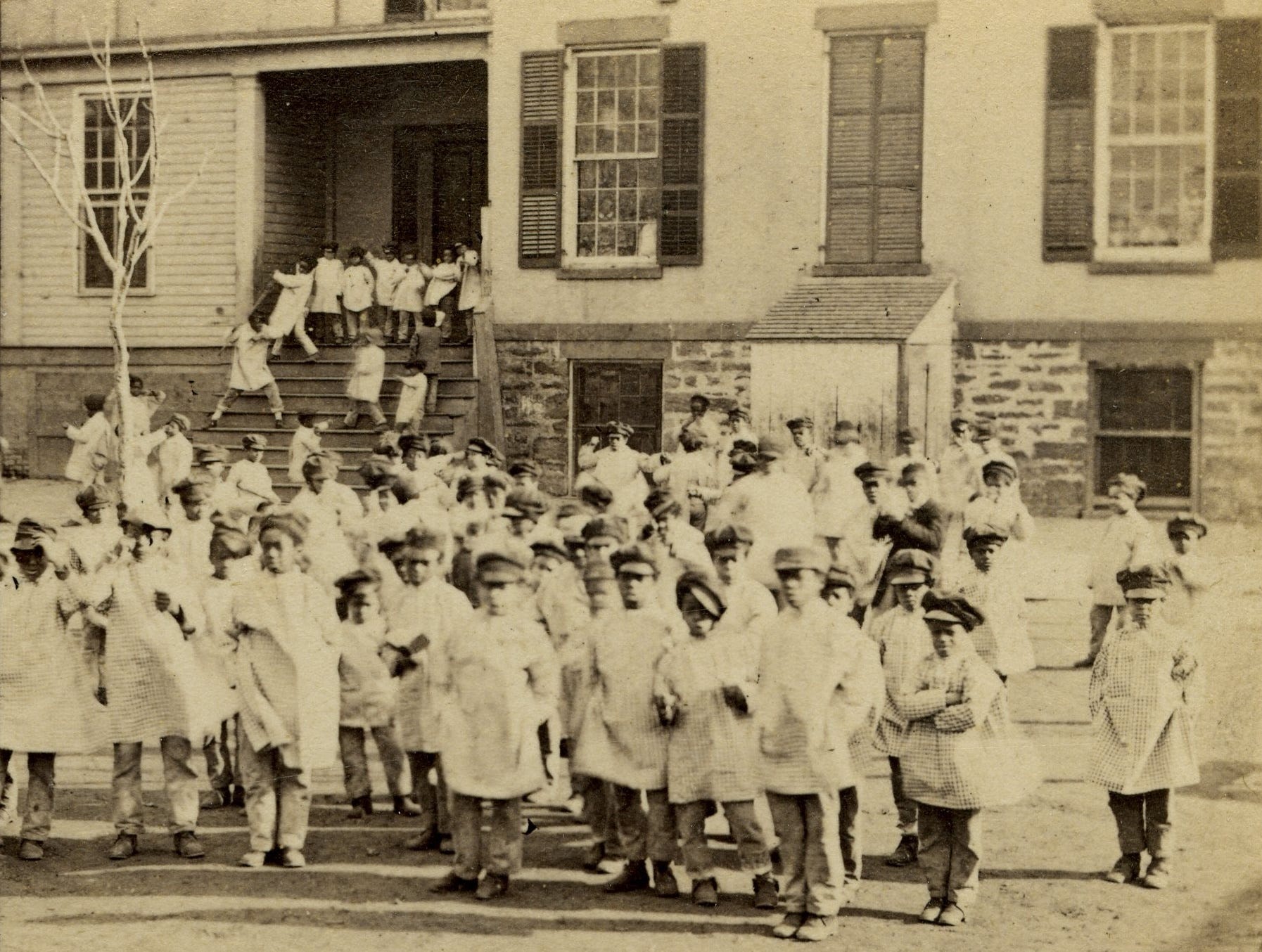
In this rebuttal to James Macdonald’s remarks accompanying his physician’s report for the Colored Orphan Asylum, McCune Smith used his expertise as a physician, methods of statistical analysis he acquired while a student at the University of Glasgow, and logical argument to refute Macdonald’s argument that the Asylum’s children had ‘peculiarities’ that made them more susceptible to fatal disease than white children. It also includes one of McCune Smith’s earliest expressions of what I call his indigeneity theory of African Americans: that African Americans had become a new, indigenous North American people, distinct from peoples of Africa and Europe while inheriting some characteristics of each, while possessing traits wholly their own, some from mixed ancestral inheritances and some influenced by the climate and geography of North America.
For McCune Smith’s first editorial rebutting Macdonald – in which he promised to write this more detailed one – see ‘Dr. Macdonald’s Report,’ The Colored American, 22 December 1838.
~ This entry is part of my project of identifying, compiling, and editing the complete written and spoken works of James McCune Smith (1813-1865) in association with Northumbria University and funded by the British Academy. ~
Title: Colored Orphan’s Asylum: Physician’s Report [and Reply]
Co-author(s): James Macdonald
Source: The Colored American, 26 January 1839, p. 2
Re-published as ‘Mortality of the People of Color’, The Emancipator (New York, NY), 7 February 1839. The Emancipator’s editorial notes attribute this work to James McCune Smith.
Text:
[James Macdonald’s report is in italics; James McCune Smith’s reply is in standard characters]
COLORED ORPHAN’S ASYLUM.
PHYSICIAN’S REPORT.
An unexpected mortality among the children of the Asylum for Colored Orphans, having caused much anxiety in the minds of the Managers, I beg leave at the request of the Secretary, to make a brief statement of each fatal case, and to point out some of the causes that have led to this unhappy result.
Though the first year of the Institution did not pass without sickness, it ended happily without a death.
The second year was ushered in differently. Sidney Johnson, a child about twelve months old, died on the third of January. He was brought from the Alms House, and though he was apparently healthy, may be supposed, from the early death of his parents, to have inherited a feeble constitution, without the opportunity of making up by early care his natural deficiencies. During the autumn following his admission into the Asylum, he suffered much from remittent fever, and finally sank under the irritation caused by teething, with a scrofulous disease not uncommon in children of his age.
Charles Barton, aged about 5 years, died on the 8th of February. He was an unfortunate child, with marked defective physical organization, malformation of the head, and all the external characteristics of mental imbecility. Always feeble and inactive, he was rather more so than usual for some weeks previous to his death, but was not considered ill until the morning of February 8th, when he was found in bed quite insensible; having probably been suddenly attacked with convulsions, the result of disease of the brain. Considering his natural infirmities, his death can be viewed with no other feeling than that of thankfulness.
Margaret Johnson, a child of 6 years old, died also in February. She had, during the previous autumn, an attack of measles, which in persons of a feeble scrofulous habit develops diseases which otherwise might remain for a long time latent. Consumption manifested itself early in the winter, and continued to progress slowly until the approach of spring, when it terminated fatally.
The next child that died was Catharine Jackson. She came to the Asylum with scrofulous ulcers of the neck during the summer of 1837, and suffered under scrofulous inflammation of the eyes in the autumn following. A troublesome cough, accompanied by gradual wasting of the body, and indicating the fatal extension of the disease to the lungs now began. She sank so rapidly about the beginning of March, that she was obliged to keep her bed. On the 14th of March, she had a fit which left her with complete palsy of one side. Four days afterwards, she died. An examination of the body next day, demonstrated that the disease had not only extended to the lungs but to the brain, thereby causing sudden death. Among the unnatural appearances of the brain, was found a large tumor on its summit containing a watery fluid.
Four deaths, and some under peculiar circumstances having taken place in the short period of four months. I felt that for the future, I owed it to myself, my profession, and the institution, to obtain information from every source as to the causes of mortality. I accordingly assumed the responsibility of examining the bodies of the children who died suddenly.
Elizabeth Jackson, aged 7 years, was taken ill on the 15th of May, and died on the 29th, of inflammation of the brain. Her head was so flat and singularly shaped that there is reason to believe she must have suffered early in life with disease of the brain. Examination of this organ after death disclosed very extensive traces of disease, some of which may have existed a long time previous to her last illness.
John Rosal, aged between 8 and 9 years, died on the 22nd of June, of consumption. He was one of those children who during the autumn of 1837 had the measles. Though troubled once or twice during the winter with a cough, which was alleviated by simple and ordinary means, my attention was not directed to his case until the 2nd of June, when I found him suffering under all the symptoms of confirmed consumption, which had for a long time been going on so insidiously as to escape observation. Examination after death showed one lung to be entirely destroyed, besides various other morbid appearances.
Henry Brown, a child of only three and a half years, was taken with whooping cough at about the same time as the other children. This, in a few days, became complicated with general inflammation of the lungs, and though actively treated, proved suddenly fatal in a paroxysm of coughing, on the 8th of August.
Ann Williams, was taken ill on the morning of the 21st; she had no pulse, and may be said to have been physically dead. Yet her mind, in an unnatural state of excitement, still lived, and she talked more during these last brief moments of existence than I had ever known her to do during the several months I had been in the habit of seeing her.―This extraordinary circumstance, added to other peculiar symptoms, induced me to suppose she must have died from eating stramonium seeds. On examination after death numerous fragments of these seeds were found in the stomach.
Matilda Delavan, the last orphan that died, was taken from a cellar in Anthony street, where she had been found, destitute of relatives, in the greatest state of wretchedness, and brought to the Asylum. She was perhaps the feeblest child ever admitted, had scrofulous swellings of the neck, and other external signs of disease that marked her as doomed to an early death. Though scarcely expected to survive the winter, she died suddenly with inflammation of the bowels.
The occurrence of nine deaths among sixty-four children belonging to the Orphan Asylum, suggests an inquiry into the causes of so unusual a mortality.
Careful examination into the history of each case, and reflection on the subject, have brought me to ascribe it to the following circumstances:
1st, The peculiar constitution and condition of the colored race.
2nd, The admission of sickly and feeble children.
3rd, Most of the children admitted, particularly the entire orphans, being the offspring of unhealthy parents.
4th, Neglect during the early periods of life―improper diet―bad air―and want of clothing―by which means constitutions naturally feeble are greatly impaired.
5th, The prevalence of epidemic diseases among the children since their admission in the Asylum.
* * * * * *
“During the autumn of 1837, the measles appeared in the Asylum, and attacked six. Though all these recovered from the disease itself, two of them sank some months after under consumption. About the same time that the measles first made its appearance, two or three of the children suffered under remittent fever from which they recovered. In the month of April, the measles made its second appearance. At this time, no less than fourteen took the disease and all recovered.
Towards the close of July, the whooping cough began to show itself, and twenty-three were soon after laboring under the disease at the same time. It proved fatal in a single instance, to one of the youngest children, in whom it induced inflammation of the lungs.
About the middle of July, two severe cases of dysentery occurred, but terminated favorably. Happily, the disease extended no farther.
During the month of October, owing probably to the vicinity of the Asylum to the country, and the decay of vegetable matter upon the surrounding vacant lots, ten of the children suffered from autumnal fever. Though three of these were dangerously ill, they have all recovered or are now convalescent.
Although, without including maladies of a milder character, such as influenza, chicken pox, &c., &c., a succession of diseases has visited the Asylum; yet these have not been so fatal here as in some other places; for according to a late report of the Hospital for sick children at Paris, the following number have been admitted and died.
                                                     ADMITTED.                        CURED.                               DIED.
With Consumption,                             82                                          0                                         50
Whooping Cough,                                53                                        27                                        20
Tubercular or Scrofulous
    inflamation [sic] of the brain,        27                                          0                                         27
Measles,                                              98                                        76                                          22

                                                                                         Respectfully submitted,
                                                                                                            JAMES MACDONALD, M.D.
Such is the Physician’s report of the cases, and such are the causes to which, in his opinion, the uncommon mortality may be attributed. As no deaths occurred during the first year, the mortality in the second year cannot be the result of any general cause, for a general cause being in constant operation, would have made a like proportion of deaths in both years. Of the five causes to which the Doctor ascribes the mortality, the first three are evidently one. For, if there be a peculiarity in the constitution of the colored people causing uncommon mortality, it is plain that their children must be “feeble and sickly,” and the “parents unhealthy.”
In search of this peculiarity, let us[1] examine the cases in rotation.
CASE 1. Sidney Johnson. In this case, the Doctor evinces a remarkable anxiety to show cause sufficient for the child’s demise. The poor infant which entered the Asylum, “apparently healthy,” died a “natural death,” and the physician, not satisfied with enumerating probabilities enough to kill any six children living, heroically rushes to the grave, exhumes the corpses of the parents and clothes them with imaginary diseases in order still more satisfactorily to “slay again the slain.”[2] Scrofula! Remittent fever!! Teething!!! Shade of Hippocrates![3] Were not these enough to kill a poor little “Colored American,” 12 months old, without raising its parents to answer for the death of their child? Dear, dear Doctor, if providence should ever bless us with a small family, and a hopeful little one becomes sick, we shall certainly employ you as the most satisfactory man in the profession. If the child recovers, you will be able to show that you have snatched it from the very jaws of death, but if you kill―No, if the patient dies, you will smother our grief in wonderment that it did not die nine times instead of one.
The infant died of teething. Now if there be any “peculiarity in the constitution of the colored race,” which causes our children to die teething, we may expect to find the fact confirmed by the report of the City Inspector:―on referring to which (Document 134, 1837) p.p. 476,[4] we find, that of the deaths caused by teething are:
                                                                    Whites . . . . . 235
                                                                    Colored . . . . . 7
which gives one colored to 33.57 white. The colored population being to the white as 1 to 16.75, it follows that two white children to one colored die of teething. Hence, if there be any “peculiarity in the constitution of the colored people,” anent[5] teething, the same is doubled in that of the white.[6]
CASE 2. Charles Barton. No adequate cause is assigned for this child’s death. All that we can gather from the report is, that on the 7th February,
                                                      “The wean slade cannie to his bed,
                                                                              But ne’er spak mair.”[7]
The Doctor thinks he died of convulsions. The inspector’s report shows that one colored to 21.36 white children die of convulsions,[8] which leaves the balance of 20 percent of “peculiarity” on the side of the whites.
CASE 3. Margaret Johnson had an attack of measles in the autumn, and died of consumption[9] in the following spring. The Inspector’s report shows that in 1837, five colored to 235 white persons died of measles.[10] That is a proportion of nearly 3 white to 1 colored. Hence, had Margaret Johnson been white, there are 3 chances to 1 that she would have died in autumn of the primary complaint―measles. So that the “peculiarity” in her constitution probably added six months to her life. But the child died of consumption. Consumption and scrofula[11] are―if we may judge from his report―two bug-bears which haunt the Doctor’s imagination.
Let us look at these complaints in relation to the colored people of this city. “Scrofula* is a disease peculiar to cold and variable climates―beyond all doubt of a hereditary nature.”[12] An ample observation enables us to say that in Great Britain, and more especially, in Scotland, this complaint pervades all ranks and ages, from the cottage to the throne. In New York, scrofula is an importation from Europe, not from Africa: and those colored people who may be afflicted with it, owe the disease to their European extraction, whilst the untainted blood of a sunnier clime enables their constitutions to withstand its ravages better than can be done by the full-blooded European. Who that reads the Doctor’s parade of scrofula in this report, will believe that the whole number of colored persons, men, women, and children, that died of this complaint in 1838,[13] amounted to the vast sum of TWO?[14] Yet such is the fact.
In the next place, are the colored people of this city more liable to consumption than the white population?
We answer―NO.
1st. Because they are not predisposed to this disease.―Predisposition to consumption consists, first, in having the scrofulous diathesis,[15] (of which we have already spoken,) and 2nd, is manifested by “bad formation of the chest, particularly, smallness of the transverse, but above all, of
* Hooper’s Med. Dict. pp. 1105.[16]
the antero-posterior diameter.”†[17] The colored people of this city have singularly well-formed chests. To those who doubt this fact, we recommend a visit to Zion’s Church on Sunday next, where they will find, for this statement, “confirmation strong as proof of holy writ.”[18]
2nd. Because the colored population in this city, are―so far as it is possible for men to be―acclimated. We have not been “transplanted to a comparatively rigorous climate,”[19] but live on the same soil where our ancestors were born, during as many, perhaps more generations than forebears[20] of Dr. McDonald’s.[21] We are, exclusively, neither of African nor European, but rather of ‘E pluribus unum’ origin[22]―we are the impersonation of the hardiest elements of every clime, and hence best fitted to endure this, in which arctic cold and tropical heat are often surpassed within the compass of a few months. For the Doctor’s information, we make the following extracts from an eminent medical writer, on the subject of migration:
“Change from a cold to a warm climate is productive of disease and great mortality in the white constitution.” “Those who change the climate progressively, or who are born in countries of an intermediate temperature, suffer much less than those who migrate in a more direct manner.” “The native African who is brought to the Southern States of North America, previously to his arrival in more Northern countries, will not suffer materially from the change.”‡[23]
3rd FACTS. Colored people in this city do not die of consumption in so large a proportion as its white inhabitants, similarly circumstanced. The natives of Great Britain and Ireland, residents in this city, are a poor and laboring class. So are the people of color. Both are exposed to the great exciting cause of consumption―“small rooms with coal stoves.”[24] Yet we find by the City Inspector’s Report, (p. 491,)[25] that only three colored, to four of this class of white citizens, fall victims to consumption. That is to say, ceteris paribus,[26] one fourth more white than colored people die of consumption.
That a smaller proportion of native white citizens die of consumption, is the result of their condition, which enables them to fly from the developement[27] of disease, by leaving the city during February and March. The majority of them have grown with the growth of our city, and are in easy circumstances. If any of them have a “hacking cough,”[28] forthwith, a consultation of physicians is summoned, the chest duly thumped, and each air cell minutely scrutinized, and the patient, whilst it is yet time, carefully packed up in a medicine chest, labelled “WITH CARE,” and invoiced for the Southern States, the south of France, or the West Indies, and diminishes the deaths by consumption in the city, by dying abroad. Or if a white mechanic be seized with the premonitory symptoms, he may easily travel South or West, and obtain wealth, and prolong life at the same time.
But how is it with the colored American? To him the avenues to wealth and the genial clime of the South, are barred by the same relentless spirit of aristocracy, which is prejudice in the North, and slavery in the South.―Hence all the colored persons in the city who are seized with consumption, die in the city of consumption; whilst the whites fly and obtain a reprieve, or die elsewhere.[29]―We often see announced in the newspapers the deaths by consumption of our fellow citizens abroad.
CASE 4. Catharine Jackson died of tumour on the brain. The City Inspector’s Report shows that one white and no colored child died of this disease.[30] Here then “peculiarity” is entirely on the side of the white population in 1837.
CASE 5. E. Jackson died of inflammation of the brain. The City Inspector’s Report shows that 1 colored to 26 white persons died of this complaint; [31] which gives a balance of 62 percent of “peculiarity” on the side of the whites.
CASE 6. John Rozal[32] died of consumption, the consequence of measles. That there is nothing peculiar in the constitution of the child in whom measles produce consumption, is plain from the remark of Andral, (Clinique Medicale, p.p. 434,) who observes that “Among the acute exanthemata,[33] there is one in particular, after which we often see pulmonary phthisis make its appearance―that is measles.”[34] He also cites the case of a young man (p. 435) “whom I (Andral) knew a long time before the attack of the measles, and was thoroughly satisfied that he presented no symptoms which could announce in him the existence of pulmonary tubercles. He had never coughed nor experienced any dyspnœa; he delivered very long lectures with a loud voice, without feeling the least fatigue.” This young man had an attack of the measles, during which he had “a distressing cough,” which within a short time terminated his existence in the form of the “last stage of pulmonary phthisis.”[35]
CASE 7. Henry Brown died of whooping cough; of which complaint 62 white and only ONE colored child died in 1837;[36] which gives to white children a quadruple “peculiarity” for dying with whooping cough.
CASE 8. Ann Williams died of accidental poisoning.―The City Inspector’s Report shows that eleven white and not one colored child died in this manner in 1837; [37] which throws the “peculiarity” entirely on the white children.
CASE 9. M. Delavon died of inflammation of the bowels. The City Inspector’s Report shows that 203 white and 17 colored persons died of this complaint in 1837.[38] This, however, is not one of “the diseases of children,” and consequently, no constitutional “peculiarity” can be deduced therefrom.
But let us investigate this subject still further. According to the Doctor’s views “peculiarity in the constitution” of a race is manifested in the mortality of its children. The following table of mortality from the principal diseases of children is carefully made up from the report of the City Inspector, [39] so often quoted.
                                       Table of mortality of children in the city of New York,
                                                              during the year 1837.
DISEASES. COLORED. WHITE.
Dropsy of the brain . . . . . . . . . . . . . . . 22 . . . . . . . . . . . . . . 343
Convulsions . . . . . . . . . . . . . . . . . . . . . 38 . . . . . . . . . . . . . . .778
Croup . . . . . . . . . . . . . . . . . . . . . . . . . . . 6 . . . . . . . . . . . . . . .145
† Andral, Clinique Medicale, pp. 437., Lond. ed. 1836.[40]
‡ Copeland’s Dict. Pract. Med. pp. 346., Lond. 1833.[41]
Whooping Cough . . . . . . . . . . . . . . . . . .1 . . . . . . . . . . . . . . . 62
 Scarlet Fever . . . . . . . . . . . . . . . . . . . . . 3 . . . . . . . . . . . . . . 576
 Measles . . . . . . . . . . . . . . . . . . . . . . . . . .5 . . . . . . . . . . . . . . 233
 Chicken Pox, aphthae, scalled[42]
 head, and worms                                    0 . . . . . . . . . . . . . . . 36
 Cholera[43] Infantum . . . . . . . . . . . . .  7 . . . . . . . . . . . . . . 246
 Teething . . . . . . . . . . . . . . . . . . . . . . . .  7 . . . . . . . . . . . . . . 235
                                                                ____                        _____
                                                                  89                           2654
Thus we find that one colored to very nearly two white children die of the diseases peculiar to infancy. If we now take into view the 4th circumstance above enumerated in the Physician’s report, and find that notwithstanding so many disadvantages, fewer colored than white children die, the conclusion is inevitable on the Doctor’s own principles, that the colored race is best fitted by nature to endure the climate of New York. And even if, as these children advance in life, the proportions in mortality be reversed, it cannot be the result of any “peculiarity of constitution,” but rather of that legalized curse which drives colored mind to prey upon itself―that hell-born prejudice which shuts out from its proper sphere the patriotic intellect of colored men, in crushing whom the state suicidally destroys the hardiest frames with which she is blessed.
For the present, we are done with the report.[44] With its author, we have no personal acquaintance, against him we entertain no feeling of malevolence. He must be a benevolent man, or he would not gratuitously perform the duties of physician to the Asylum. That the views taken by him in his report are erroneous, is manifest from the above statements in figures “which cannot lie,” and which administers to him a rebuke more stern than we can pen.
We must confess that it is with painful feelings that we have hurriedly thrown together these remarks. Next to our Maker do we revere Science[45] as the clearest manifestation of his law which he has vouchsafed us. And we have hoped for much from Science; born in penury, nursed by persecution, we have fondly dreamed that she would ever rear her head far above the buzz of popular applause, or the clash of conflicting opinion in the moral world; it is therefore almost with the anguish that springs from a blasted hope that we view this first, however flimsy, attempt to demean her to the contemptible office of ministering to public prejudices.
[1] This editorial ‘us’ would refer to James McCune Smith. McCune Smith’s authorship of this anonymous editorial rebuttal is established by his (likewise anonymous) promise to ‘professionally say more on [the] subject’ of Macdonald’s report in ‘Dr. Macdonald’s Report’, The Colored American, 22 December 1838. McCune Smith was engaged as co-editor of the Colored American in early December, and he was the only physician who was a contributor and co-editor for the paper. See ‘Our Next Volume’, The Colored American, 8 December 1838.
[2] From ‘Sooth’d with the Sound the King grew vain, / Fought all his Battles o’er again; / And thrice he routed all his Foes, and thrice he slew the Slain’ in John Dryden’s ode ‘Alexander’s Feast.’ See Dryden, Alexander’s Feast, 3 (1780 publication in Internet Archive). McCune Smith had also quoted from this stanza in ‘Speech of James McCune Smith at the Anniversary Meeting of the American Anti-Slavery Society, 8 May 1838’, in Fifth Annual Report of the American Anti-Slavery Society: With the Speeches Delivered at the Anniversary Meeting. 8th May 1838 (American Anti-Slavery Society, 1838), 28 (In Internet Archive).
[3] McCune Smith appears to be calling on the ghost of Hippocrates, the Father of Medicine, to witness Macdonald’s irresponsible diagnostic speculation here.
[4] See ‘Annual Report of Interments’, 476–77 (In Hathi Trust).
[5] An archaic English/Scots word still in use during McCune Smith’s time in Scotland; McCune Smith used ‘anent’ in its meaning ‘concerning, about, [or] in relation to.’ See John Jamieson, An Etymological Dictionary of the Scottish Language (Edinburgh: Printed for A. Constable and Company, and A. Jameson by Abernethy & Walker, 1818) entry for ‘anens, anenst, anent, anentis’ (not paginated).
[6] This and the other data McCune Smith subject to statistical analysis from Macdonald’s physician’s report represent his first (known) employment of that emerging science to rebut claims of inferiority of people of African descent in a published work. It is very far from McCune Smith’s last work of this kind.
[7] This a near-verbatim quote of a verse from Robert Burns’ poem ‘Death and Dr. Hornbook:’ ‘The wife slade cannie to her bed/But ne’ver spak mair.’ McCune Smith substituted ‘wean’ for ‘wife’ to tailor the quote to illustrate Charles Barton’s case: ‘wean’ is Scots for ‘child.’ See Jamieson, Etymological Dictionary, entry for ’wean, weeane.’. The original verse translates to: ‘The wife slid cautiously (or prudently) to her bed/But never spoke again.’ (Translated using the same dictionary.)
[8] See ‘Annual Report of Interments’, 474–75 (In Hathi Trust).
[9] Hooper’s Medical Dictionary (see McCune Smith’s citation of this work below and associated footnote outlining his history of consulting this work) defines ‘consumption’ (derived from Latin) as ‘to waste away,’ and directs the reader to ‘phthisis’ (derived from Greek), meaning ‘pulmonary consumption,’ (now called tuberculosis) which was subdivided into several ‘species’ of disease. See Robert Hooper, Lexicon Medicum, or, Medical Dictionary: Containing an Explanation of the Terms in Anatomy, Botany, Chemistry, Materia Medica, Midwifery, Mineralogy, Pharmacy, Physiology, Practice of Physic, Surgery, and the Various Branches of Natural Philosophy Connected With Medicine (Longman, Rees, Orme, Brown, and Green, 1831), 422, 965–66 (In Internet Archive).
[10] The proportion reported was actually 5 to 233. See ‘Annual Report of Interments’, 474–75 (In Hathi Trust).
[11] Hooper’s Medical Dictionary defines ‘scrofula’ (derived from Greek) as a ‘disease very difficult to define’ but characterized by ‘hard indolent tumours of the conglobate glands in various parts of the body, but particularly in the neck, behind the ears, and under the chin, which, after a time, suppurate and degenerate into ulcers.’ See Hooper, Lexicon Medicum, 1105 (In Internet Archive). It’s now known to be caused by an infection of the lymph nodes, by tuberculosis and other bacteria.
[12] See Hooper, Lexicon Medicum, 1105 (In Internet Archive).
[13] This should read ‘1837.’
[14] See ‘Annual Report of Interments’, 478–79 (In Hathi Trust).
[15] Hooper’s Medical Dictionary defines ‘diathesis’ (derived from Greek) as ‘A particular state of the body: thus, in inflammatory fever, there is an inflammatory diathesis, and, during putrid fever, a putrid diathesis.’ See Hooper, Lexicon Medicum, 483 (In Internet Archive).
[16] McCune Smith checked out the 1831 single-volume edition of Robert Hooper’s Medical Dictionary (first published in 1798) from the University of Glasgow’s main library on 10 June 1835 and returned it on 5 August, as a student in the Moral Philosophy class. This was the summer before he first enrolled in medical school, on 5 November 1835. The edition McCune Smith cited here has the same pagination and hence, almost certainly the same text. See Hooper, Lexicon Medicum, 1105; University of Glasgow, Students Receipt Book: Alphabetically, 629; University of Glasgow, University Register: Medicine 1822-23 to 1842-43 (Glasgow, 1843), GUA31247, p. 84, University of Glasgow Archives & Special Collections.
[17] See Gabriel Andral, The Clinique Médicale, or, Reports of Medical Cases, trans. Daniel Spillan (Henry Renshaw, 1836), 437 (In Internet Archive).
[18] This is a near-verbatim quote from Shakespeare’s Othello: ‘…confirmations strong/As proofs of holy writ.’ See William Shakespeare, The Plays of William Shakspeare, with George Steevens et al. (J. Johnson [and others], 1803), 19:394 (In Internet Archive).
[19] Here, McCune Smith quoted a phrase from Macdonald’s original physician’s report for the Asylum, which he didn’t include in the above-quoted sections. A copy of the full text has not been found, but Macdonald also quoted this same phrase from his report in a reply to a letter from the English phrenologist and reformer George Combe on the ‘injurious effects of low vegetable diet on the health of the children in the Asylum for Colored Orphans in New York city’ which he has remarked on ‘In my lectures on Education, delivered in New York and New England in 1839.’ See ‘Vegetable Diet for Children’, The Boston Medical and Surgical Journal 22, no. 20 (1840): 309–10. McCune Smith attended some of Combe’s lectures on phrenology which he delivered in New York City during that same 1839 trip to the United States, at Combe’s invitation. See James McCune Smith, ‘Mr. George Combe’s Lectures’, The Colored American, 18 May 1839; George Combe, Notes on the United States of North America, During a Phrenological Visit in 1838-39-40 (MacLachlan, Stewart, & Company, 1841), 2:190, 224.
[20] Misspelled ‘forbears’ in the original printing.
[21] Misspelling of Macdonald’s last name in original printing.
[22] This is among McCune Smith’s earliest expressions of what I call his ‘indigeneity theory’ of African Americans: that African Americans had become a new indigenous North American people, distinct from peoples of Africa and Europe while inheriting some characteristics of each, and at the same time possessing traits wholly their own, some from mixed ancestral inheritance and some influenced by the climate and geography of North America. See, for example, ‘African Colonisation I, NASS, 28 Aug 1851’; ‘On the Fourteenth Query of Thomas Jefferson’s Notes on Virginia’, The Anglo-African Magazine, August 1859, 236–37; ‘Note from Mr. Tilton, AA, 3 Oct 1863’. McCune Smith employed the motto ‘E Pluribus Unum’ to describe the multiracial composition of the United States’ and/or African Americans on other occasions as well; see ‘Extracts from Dr. Smith’s Journal [23 August - 3 September 1832]’, The Colored American, 2 December 1837; ‘Civilization: Its Dependence on Physical Circumstances’, The Anglo-African Magazine, January 185, 16.
[23] These quotes are from James Copland, A Dictionary of Practical Medicine: Comprising General Pathology, the Nature and Treatment of Diseases... (Lilly, Wait, Colman, and Holden, 1834), 1:348 (In Internet Archive). See McCune Smith’s citation below and associated footnote outlining his history of consulting this work.
[24] Another source for this quote has not been found.
[25] See ‘Annual Report of Interments’, 491 (In Hathi Trust).
[26] Latin for ‘All other things being equal’, or in other words, ‘The circumstances being the same in both cases.’ See David E. Macdonnel, A Dictionary of Select and Popular Quotations... Taken from the Latin, French, Greek, Spanish and Italian Languages (A. Finley, 1824), 41.
[27] McCune Smith usually spelled ‘development’ this way, an idiosyncrasy that further supports the case for McCune Smith’s likely authorship of unsigned works that contain the word. (Also the case for ‘develope’/develop.)
[28] See James Copland, A Dictionary of Practical Medicine. Comprising General Pathology, the Nature and Treatment of Diseases..., V (Harper & Brothers, 1847), 988 (In Internet Archive). A copy of an 1830’s edition of this work that McCune Smith probably quoted this from wasn’t accessible.
[29] McCune Smith regularly pointed out this type of statistical error when analysing conclusions which he believed were wrongly derived from data because, as in this case, the analysis failed to account for factors which would distort the data set. For example, when critiquing the New York Homœopathic Dispensary Association’s claims of the superior success of homeopathy in treating children in asylums, McCune Smith similarly observed that, in the case of entries in the Protestant Half Orphan Asylum’s medical records, ‘These entries have a suspicious look. They indicate a custom of quietly thrusting away from this charity the very sick children, in order that they might die elsewhere.’ See his ‘Lay Puffery of Homœopathy’, The Annalist: A Record of Practical Medicine, in the City of New York 2, no. 18 (1848): 350. (In Hathi Trust)
[30] See ‘Annual Report of Interments’, 474–75. (In Hathi Trust)
[31] See ‘Annual Report of Interments’, 474–75. (In Hathi Trust)
[32] Spelled ‘Rosal’ in Macdonald’s report above.
[33] Misspelled ‘exanthematar’ in the Colored American. Exanthemata refer to ‘eruptive fevers,’ or diseases in which fever is accompanied by a rash. See Hooper, Lexicon Medicum, 666.
[34] See Andral, Clinique Médicale, 434 (In Internet Archive).
[35] See Andral, Clinique Médicale, 435 (In Internet Archive).
[36] See ‘Annual Report of Interments’, 474–75 (In Hathi Trust).
[37] See ‘Annual Report of Interments’, 478–79 (In Hathi Trust).
[38] See ‘Annual Report of Interments’, 476–77 (In Hathi Trust).
[39] See ‘Annual Report of Interments’, 474–77 (In Hathi Trust).
[40] The page number here contains a typo. See quote in Andral, Clinique Médicale, 437 (In Internet Archive).
[41] This is a citation from the first volume of James Copland’s Dictionary of Practical Medicine. McCune Smith had borrowed the third volume from the University of Glasgow’s medical library in January 1836 during his first year of medical school; see University of Glasgow, Register of Loans, 283. A copy (digital or physical) of the 1833 London edition that McCune Smith cited here hasn’t been found, but an American edition from the following year has nearly the same pagination and, correspondingly, presumably nearly the same text. See Copland, Dictionary of Practical Medicine, 1:348 (In Internet Archive). See the history of the first publications of Copland’s ambitious multi-volume work – including the September 1833 second volume apparently cited here – which went on to be published in many editions over the ensuing decades, in Simon Gray, ‘Dr James Copland (1791–1870) and His Dictionary of Practical Medicine’, Journal of Medical Biography 31, no. 3 (2023): 191.
[42] This may be a misspelling of ‘scaled.’ Hooper’s dictionary defines ‘scale’ as ‘A lamina of morbid cuticle, hard, thickened, whitish, and opake…’ See Hooper, Lexicon Medicum, 1096.
[43] Misspelled ‘Colera’ in the original printing.
[44] The Boston Medical Journal published a short commentary on Macdonald’s report and McCune Smith’s rebuttal, which includes: ‘The report been most singularly criticised and skeletonised in a paper called the Colored American, conducted by a pair of shrewd colored editors.’ See ‘Medical Miscellany’, The Boston Medical and Surgical Journal 20, no. 1 (1839): 19.
[45] McCune Smith’s reverence for science may have been at least partly inculcated in his early youth by ‘Hymn to Science’ in John Platt’s Literary and Scientific Class Book, among the books that students read at the African Free School. See Andrews, History, 72. For the text of ‘Hymn to Science,’ see John Platts, The Literary and Scientific Class Book, ed. Levi W. Leonard (John Prentiss, 1827), 10–12 (In Internet Archive).